
Jellyfish Energy removes the trade-off between speed and accuracy in business energy pricing

Bespoke electricity and gas prices in approximately one second, replacing broad pricing bands and lengthy manual quotation processes with instant, meter-level calculations.
Jellyfish Energy has launched a new approach to business energy procurement, delivering individually calculated electricity and gas quotations in milliseconds through its proprietary pricing technology.
The development addresses a longstanding challenge in the business energy market: obtaining a price quickly has traditionally meant sacrificing some degree of individual pricing accuracy, while obtaining a genuinely bespoke quotation has often required hours or days of manual assessment.
Jellyfish has brought these two approaches together, making granular, meter-level pricing available on demand, alongside multi-site procurement and digital contracting through its Medusa partner platform and API.
In an internal live portfolio test conducted on 31 October 2026, Jellyfish tested pricing across a sample of more than 4,000 electricity and gas meters, producing thousands of successful bespoke quotations.
The results demonstrated:
-
1,126 milliseconds: Median measured quotation time across electricity and gas, approximately 1.1 seconds.
-
937 milliseconds: Median measured quotation time for electricity.
-
Under three seconds: At least 95% of successful quotations completed within this time.
The technology supports individual business premises and portfolios of up to 250 meters, allowing partners to obtain tailored prices and progress customers through to signed contracts within one connected workflow.
Challenging how business energy has traditionally been priced
For years, business energy suppliers have largely relied on two methods of providing quotations.
The first uses standardised pricing files or matrices, grouping customers into predefined categories based on factors such as consumption, meter type, region and contract duration.
These pricing structures allow suppliers and intermediaries to produce quotations quickly, while simplifying the management of wholesale exposure, operational complexity and pricing risk.
However, the approach comes with limitations.
Businesses within the same pricing category can have substantially different consumption patterns, supply requirements and underlying costs. Applying the same standardised rates can mean that individual customers are priced less precisely than their circumstances would otherwise justify.
A business may therefore receive a higher price simply because it falls within a particular pricing band, rather than because its individual energy requirements warrant that cost.
The second approach is bespoke pricing, where a supplier assesses an individual customer’s requirements and calculates a tailored quotation.
While this can provide greater precision, the process has traditionally involved manual intervention from pricing, trading, finance or risk teams. Depending on the complexity of the request, quotations can take hours or even days to produce.
Access is also commonly restricted to business hours, when the relevant teams are available to review and approve pricing.
For intermediaries, this creates delays between speaking with a customer and receiving an actionable quotation. For businesses, it can mean waiting for a price that reflects their actual circumstances.
Jellyfish’s technology is designed to remove that compromise, combining the individual assessment associated with bespoke pricing with the speed and accessibility of automated quotations.
Instead of relying on broad pricing bands or requiring manual intervention for every tailored quotation, Jellyfish calculates prices automatically using the characteristics and costs associated with each individual meter.
The result is a bespoke quotation available on demand, without the conventional waiting period.
Every meter priced on its own merits
At the centre of the development is Vortex, Jellyfish Energy’s proprietary electricity pricing engine, which brings together meter characteristics, expected consumption, contract dates and the latest available wholesale, network and policy costs.
Rather than assigning businesses to broad pricing categories, the engine calculates prices using the individual requirements of each supply point.
For half-hourly electricity meters, available industry consumption data provides further insight into when electricity is actually used.
These patterns can inform annual consumption, day and night usage, and estimated capacity requirements, allowing the pricing process to account for the operational characteristics of the business.
A daytime office, a manufacturing facility operating overnight and a business with irregular consumption can have materially different energy requirements, even where their total annual consumption is similar.
By considering those differences, Jellyfish can calculate prices that more closely reflect each meter’s underlying cost profile.
Gas quotations similarly account for factors including supply region, expected consumption and contract commencement date.
This approach also provides greater pricing transparency and consistency, applying defined calculations and available cost inputs rather than relying on repeated manual assessments.
For customers, the benefit is more individually considered pricing. For Jellyfish, automation enables granular calculations to be performed at scale while maintaining structured pricing and risk controls.
From days of waiting to seconds of conversation
The impact extends beyond how prices are calculated.
Under conventional bespoke pricing processes, an intermediary may need to collect customer information, submit a request to the supplier and wait for the relevant pricing team to return a quotation.
During that time, the customer may continue exploring alternatives, market conditions may change, and the opportunity to conclude a contract can be lost.
With Jellyfish’s automated approach, partners can request individually calculated quotations while speaking directly with the customer.
The technology is not dependent on pricing teams being available to manually process each request, making automated quotation capability accessible outside conventional working hours.
This changes the role of bespoke pricing from a separate administrative process into an immediate part of the customer conversation.
It also reduces repeated data entry, manual handovers and the operational workload traditionally associated with preparing individual quotations.
For partners handling large numbers of customers, the ability to obtain granular pricing in seconds creates an opportunity to deliver a more responsive service without abandoning the detail of bespoke procurement.
One premises or 250 meters, one connected process
The release extends this capability beyond individual quotations, bringing multi-site procurement, commercial comparisons and electronic contracting into a single workflow.
Through Medusa and its API, partners can:
-
Quote up to 250 meters in one portfolio: Obtain individual electricity and gas quotations across multiple premises, with consolidated cost comparisons.
-
Plan contracts around business requirements: Compare available contract durations and align meters to a common end date, including supplies with different commencement dates.
-
Combine electricity and gas: Bring selected meters across both fuels into one contract with detailed meter schedules.
-
Complete contracts digitally: Generate paperwork, send it through Dropbox Sign, monitor signature progress and retrieve completed agreements.
-
Manage price validity: Align signing deadlines with quotation expiry and review refreshed prices where an unsigned quotation has expired.
-
Adjust commercial arrangements instantly: Change partner commission and immediately see the impact on quoted rates, estimated customer costs and earnings.
CSV and PDF summaries allow partners to present their recommendations, while portfolio management tools identify meters requiring attention without preventing progress on the remaining sites.
For larger businesses, this means individual premises can receive pricing appropriate to their requirements while remaining part of a coordinated procurement strategy.
The API also makes these capabilities available for integration into partners’ own systems, removing the need to rely exclusively on Jellyfish’s Medusa interface.
Built to change expectations, not just quotation times
Aidon Hudson, Chief Executive of Jellyfish Energy, said:
“Business energy pricing has traditionally involved a compromise. You could have a price quickly using a standard pricing file, or you could request something genuinely bespoke and potentially wait hours or days for it.
“Standardised pricing files serve a purpose, but they inevitably group businesses together. Two customers can have very different energy requirements and still receive pricing based on the same broad assumptions. That’s not necessarily the most accurate reflection of what each business should cost to supply.
“We wanted to remove that compromise entirely.
“By building our own pricing technology, we can calculate the costs associated with individual meters and return tailored quotations in around a second. There’s no need for a pricing team to manually assess every request, and our partners don’t have to wait until the next working day to get an answer.
“What makes this particularly exciting is that we’ve connected the pricing directly to the rest of the procurement journey. Whether a customer has one meter or 250, our partners can price, compare, structure and complete contracts through one system.
“For us, this is about challenging the way business energy has always been sold. Bespoke pricing shouldn’t be something businesses have to wait for, and speed shouldn’t have to come at the expense of individual consideration.”
Innovation backed by nationally recognised growth
The launch follows Jellyfish Energy being named the 13th fastest-growing company in the UK in the 2026 UK Fast Growth Index, alongside recognition as the leading business-to-business services firm in the North of England.
The recognition followed turnover growth of 1,070% between 2023 and 2025, reaching approximately £10 million.
Jellyfish’s technology-led approach has also extended into payments innovation. In March 2025, GoCardless announced the first recurring Pay by Bank transaction on Jellyfish’s behalf during live bank testing.
The latest development reflects Jellyfish’s continued investment in proprietary technology, combining pricing, risk management, partner distribution and customer contracting within its own platforms.
By automating calculations traditionally associated with manual bespoke procurement, Jellyfish is seeking to establish a new expectation for how quickly businesses can access individually considered energy prices.
Every meter considered. Every site connected. Bespoke prices at the speed of a conversation.
More good reading.
All stories
Jellyfish Energy named 13th fastest-growing company in the UK
We’re proud to have been named the 13th fastest-growing company in the UK and the top B2B services firm in the North of England in the 2026 UK Fast Growth Index. With 1,070% growth in turnover, we’re …
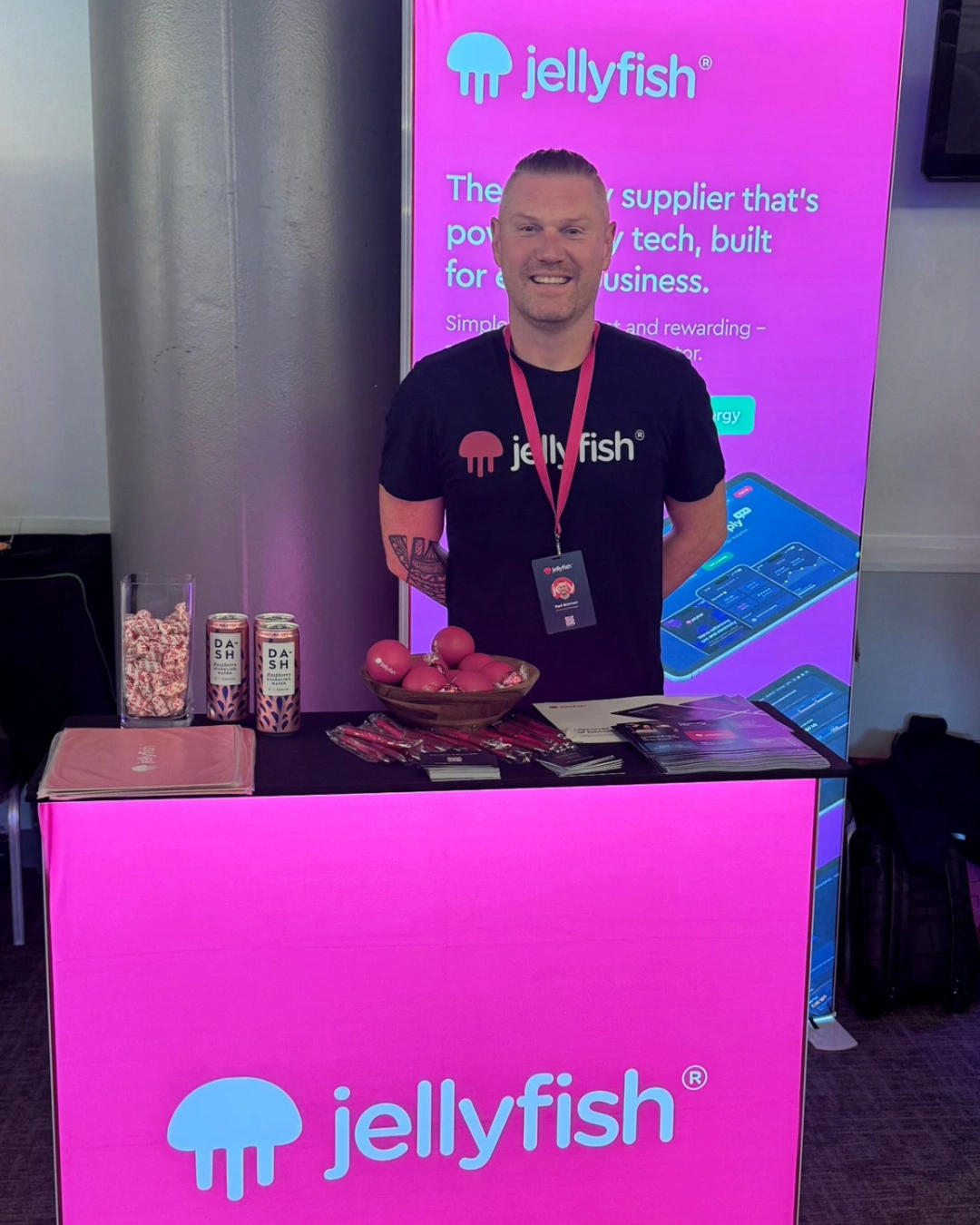
Jellyfish at the Scotland Expo
This week, we had the opportunity to exhibit at the Scotland Expo - and it was an amazing experience!
Stay Vigilant
Here at Jellyfish Energy, trust is the foundation of everything we do. You deserve to interact with us in a secure, transparent, and safe environment - so protecting your business and personal informa…